How to Check Casino Legitimacy: What Reopening Stories Reveal About Operator Safety
Learn how to check casino legitimacy step by step: find and verify licence numbers, spot red flags, research owners and judge player protection before you play.
Checking casino legitimacy means confirming three things: who licensed the operator, who actually owns it, and whether it has a record of paying people. That’s the short version. The complication is that most players stop at the first one, see a licence logo in the footer, and assume the other two are handled. They aren’t. A licence is the entry ticket, not the full safety certificate.
The most useful way to learn what real scrutiny looks like is to watch a land-based casino try to reopen. Nobody rebuilds a gaming floor quietly. Every step gets inspected, costed and argued over in public, which means the paperwork trail is visible. Online, that same trail exists, it’s just thinner and nobody walks it for you.
What casino reopenings reveal about operator legitimacy
Take the casino at San Martín in Argentina’s Mendoza province. A fire in March 2026 destroyed the venue and part of the attached shopping centre. Six months later the operator, Grupo Kristich, was rebuilding the Tótem Boulevard complex with the aim of restarting in the first half of December 2026, with an investment reported in the range of ARS 18–20 billion, 1,700 square metres of new covered space taking the complex to 7,000 m², and retail units expanding from 12 to roughly 30.
That tells you what a legitimate operator has to put on the table: capital, a rebuild plan that satisfies a provincial gaming authority, and a compliance history good enough to keep the gaming annex authorised. You cannot bluff your way back onto a regulated gaming floor.
The less flattering part of the story is just as instructive. Reports around the reopening also described the dismissal of 82 employees from the traditional gaming department and outstanding tax liabilities. Neither detail makes the operator illegal. Both tell you something about how it handles obligations when money is tight, and that is exactly the question you should be asking about any site holding your deposit.
So the thesis for the rest of this guide: judge an online casino the way a regulator judges a reopening. Licence status, financial backing, compliance record, and conduct towards the people it owes money to. In that order.
How to verify a casino licence
Verification takes about ten minutes and it is the single highest-value thing you can do before depositing.
Finding official licence numbers
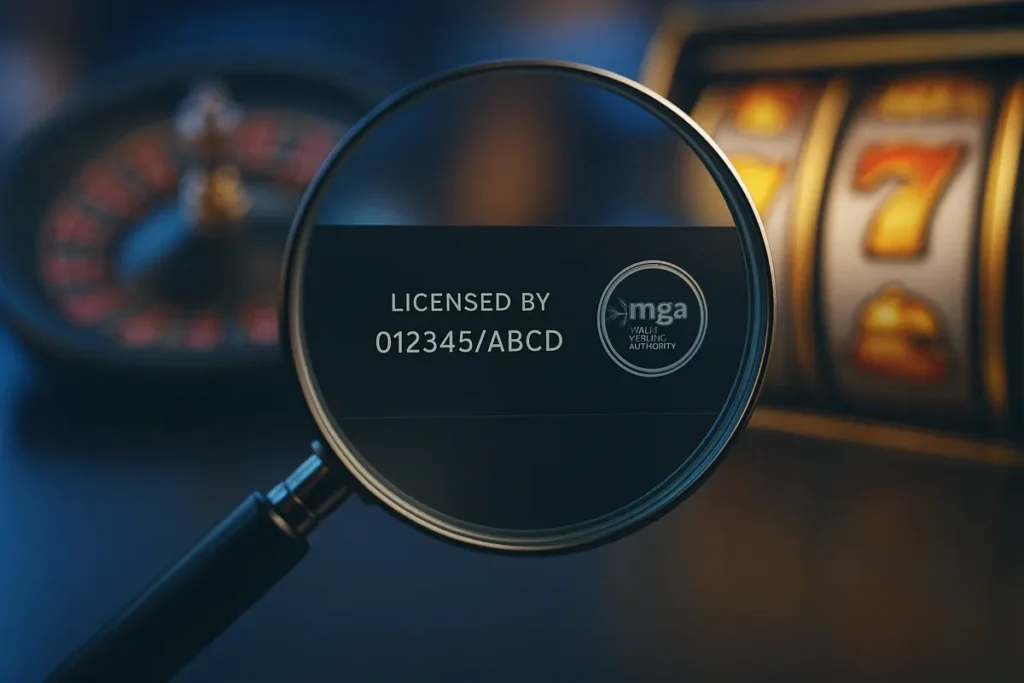
Scroll to the very bottom of the homepage. A properly licensed operator states, in plain text, the registered company name, the registration number and address of that company, the licensing authority, and a licence number. Something like “operated by [Company] Ltd, registration number X, licence number Y, issued by [authority]”.
Copy that licence number. If the footer shows only a logo with no number, or the licence text is an image you can’t select, treat that as the first warning rather than a design quirk. Also check the “About” and “Terms and Conditions” pages, where the licensed entity is usually named again. If the two names don’t match, ask support why.
Checking with regulatory authorities
Do not click the operator’s licence badge and trust where it lands. Open a new tab, type the regulator’s own website address yourself, and find its public register of licensees. Then:
- Search the register by licence number, or by the company name if number search isn’t offered.
- Confirm the status reads as active, not expired, surrendered or suspended.
- Check the listed domains. Licences name the specific websites they cover. If the site you’re on isn’t listed, you are not covered by that licence, even if the company is real.
- Check what the licence permits. Some cover casino games only, some add sportsbook or live dealer.
- Note the date the licence was issued. A licence granted last month tells you nothing about track record.
If a regulator has no searchable public register at all, that is itself a finding about how much protection the licence buys you.
Understanding licence types and jurisdictions
Not all licences do the same job. A B2B or software supplier licence covers a game studio, not the site taking your money, and some operators display supplier certificates to look regulated. A remote gaming licence covers online play; a land-based permit does not.
Jurisdiction matters more than most players realise, because it decides who hears your complaint when a withdrawal stalls.
| Licensing authority | What it typically covers | What recourse usually looks like |
|---|---|---|
| Malta Gaming Authority | Remote operators serving multiple markets | Published complaints procedure; players can escalate after the operator’s own process |
| UK Gambling Commission | Operators serving Great Britain | Strict conditions plus mandatory independent dispute resolution, but these sites generally do not accept Indian players |
| Gibraltar, Isle of Man | Established remote operators and groups | Formal regulator oversight, written complaint routes |
| Curaçao | A long-standing hub for offshore brands, now moving to a direct licensing regime under its own gaming authority | Improving, but check the current status of the specific licence rather than assuming |
| Small light-touch jurisdictions (for example Anjouan-type licences) | Low-cost offshore registrations | Little practical complaints machinery; in effect you rely on the operator’s goodwill |
| Indian state regimes (Sikkim, Nagaland; land-based in Goa, Daman, Sikkim) | Specific games under specific state rules | Domestic legal footing, but narrow in scope |
For Indian players there’s an unavoidable caveat. The legal position on real-money online gaming in India has been tightening and differs by state, and most international brands accepting rupee deposits hold offshore licences. That means an Indian regulator is not going to recover your balance for you. Check the current rules that apply where you live before you deposit, and understand that offshore licensing shifts the burden of due diligence onto you.
Red flags that signal an illegitimate operator
Safe online casinos are boring in a specific way: the terms are dull, the limits are stated, the support is slow but real. Trouble advertises itself.
Missing or fake licensing information
- A licence logo with no number, or a number that returns nothing in the regulator’s register.
- Claims of being “licensed and regulated internationally” with no authority named.
- A licence held by a different company than the one named in the terms.
- The domain you’re playing on is absent from the licence record.
- Invented bodies with official-sounding names and no public register.
Suspicious bonus terms
Bonuses aren’t a red flag. Bonus terms designed to be unwinnable are. Read for wagering requirements (30x to 60x on the bonus is common; 60x on bonus plus deposit is punishing), maximum cashout caps that quietly limit a ₹50,000 win to ₹5,000, maximum bet rules while a bonus is active, game weighting that makes table games contribute 10% or nothing, and expiry windows of a few days. Then look for the clause that lets the operator void winnings at its “sole discretion” with no stated grounds. That clause is where disputes go to die.
Poor payment and withdrawal practices
Watch for KYC being demanded only after you request a cashout, document requirements that grow each time you comply, “pending” periods long enough to tempt you into reversing the withdrawal, weekly caps so low that a decent win takes months to pay out, and deposit methods that work instantly while withdrawals mysteriously need a different route. Test the system early with a small withdrawal before you ever hold a large balance.
Checking operator reputation and financial stability
Researching parent company and ownership
The terms and conditions name the legal entity. Search that name, not the brand. You are looking for how long the company has existed, what other brands it runs, and whether it belongs to a group that publishes financial results or files public accounts. Listed parent companies are not automatically kinder, but they are accountable to someone other than themselves. If several sites share identical terms word for word, they share an owner, and a bad payout record at one is a fair guide to the others.
Reading player reviews and complaints
Ignore star ratings. Read the complaint threads and follow the pattern: does the operator respond with specifics, does it name the clause it relied on, does the player eventually get paid? One furious review means nothing. Twenty reports of the same stalled-withdrawal script means a lot. Be sceptical of walls of five-star reviews posted within days of each other, and of review sites that rank operators by affiliate payout.
Checking financial stability indicators
You won’t get a balance sheet, but you can read proxies. Consistent payout speed over months is the strongest one. Look for a stated policy on holding player funds separately from operating funds, a sensible relationship between the size of jackpots offered and the scale of the group, and years of continuous operation under the same licence. Treat a sudden burst of extravagant promotions from a struggling brand the way you would treat a shop announcing a closing-down sale.
Player protection standards legitimate operators provide
Responsible gambling tools and limits
Gambling regulation in serious jurisdictions obliges operators to give you working controls: deposit, loss and session limits, time-outs, cool-off periods, self-exclusion, and reality checks that interrupt play with time and spend reminders. Find these in account settings before you deposit. Decreases should apply immediately; increases should involve a waiting period. A site that buries these tools, or makes you email support to set a deposit cap, is telling you what it prioritises. Our responsible gambling guide covers how to use these settings properly.
Dispute resolution and customer support
A legitimate operator publishes a complaints procedure with timeframes, names the independent dispute resolution body or regulator you can escalate to, and gives you a human on live chat or email who can reference your account. Test support with a real question before depositing. Vague answers now become unanswered emails later.
Data protection and fair gaming
Games should be tested by an independent lab such as eCOGRA, GLI, iTech Labs or BMM, with results or certification available. RTP should be published per game, and you should understand what it means: 96% RTP is the long-run average return across millions of rounds, which is the same as saying the house holds a 4% edge. That edge never disappears, no strategy removes it, and verification work protects you from being cheated, not from losing. Crash games may offer provably fair verification using server and client seeds. On the data side, look for encrypted connections, a privacy policy that explains how KYC documents are stored, and no requests for documents over unsecured chat or messaging apps.
A ten-minute verification routine
- Copy the licence number from the footer and find it in the regulator’s own register, including the domain.
- Search the registered company name and check what else it operates.
- Read the bonus terms for wagering, max cashout, max bet and game weighting.
- Read the withdrawal section for caps, timeframes and KYC rules.
- Open account settings and confirm deposit limits and self-exclusion exist.
- Message support with one specific question and judge the reply.
- Deposit small, complete KYC immediately, and test a withdrawal.
Frequently asked questions
What makes a casino legitimate?
An active licence from a named authority, covering the exact domain you’re playing on, held by a clearly identified company, with independently tested games, published complaints and dispute routes, working responsible gambling tools, and a demonstrated record of paying withdrawals.
Where do I find casino licensing information?
In the website footer and the terms and conditions, where the licence number, authority and registered company details should appear in text. Verify it on the regulator’s public register, reached by typing the regulator’s address yourself.
How do I check an operator’s reputation?
Search the legal entity rather than the brand, read complaint threads for resolution patterns instead of star ratings, check how long the licence has been held, and look for sister brands with shared terms. Cross-check against independent casino reviews that disclose how they are funded.
Does a licence guarantee I’ll be treated fairly?
No. It guarantees someone can be complained to, and that the games have been tested. The house edge still applies to every bet you place. Set limits, play with money you can afford to lose, and if gambling stops feeling like entertainment, use the self-exclusion tools or contact a support service in your area.