How Casino Game Provider Deals Shape Your Slot Selection
Casino game providers explained: how slot studios like Wazdan, aggregators such as Games Valley and operators decide which games reach your lobby.
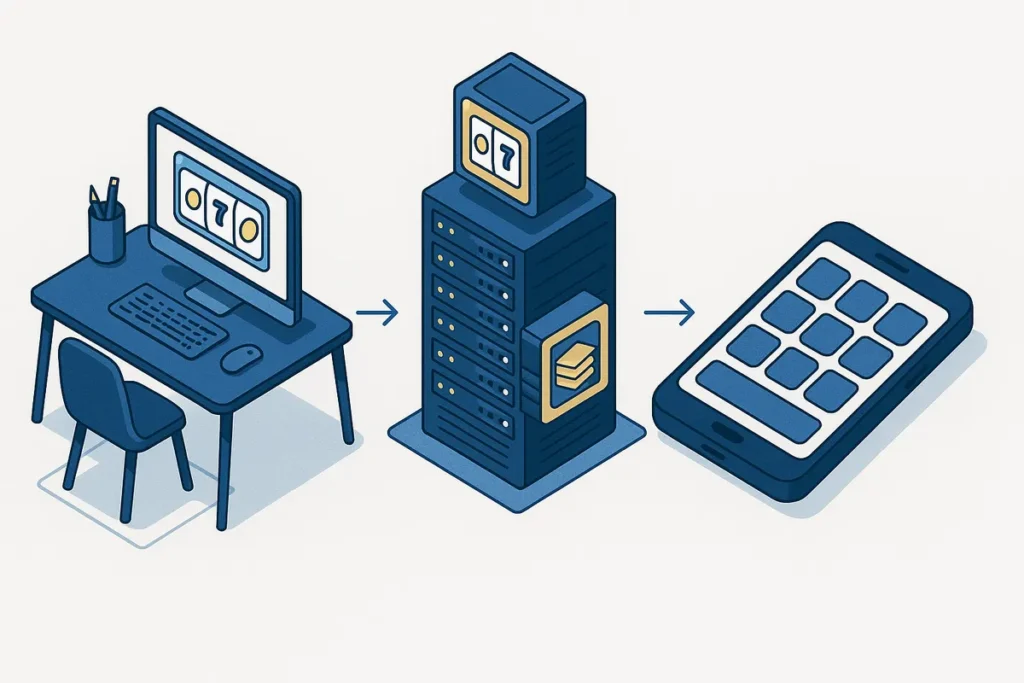
Casino game providers explained: the three-step chain behind every lobby
One aggregation platform, Games Valley, gives operators access to more than 15,000 slot titles. Your casino’s lobby shows you a sliver of that. Why the gap? Because between the studio that builds a slot and the thumbnail you tap, there are two more businesses making commercial decisions you never see.
Here is casino game providers explained in one sentence: studios build the games, aggregators bundle thousands of them into a single technical package, and operators (the casino brands) pick which bundles and which titles to switch on. The film industry analogy holds up well. A studio shoots the movie, a distributor sells it to cinema chains, and your local cinema decides which screens it gets and for how long. Same film, different availability depending on where you live and who struck which deal.
To make this concrete, I’ll follow one real deal through the chain: Wazdan’s new partnership with Games Valley, announced in late September 2026. By the end you’ll know exactly why a slot you loved last month has vanished from your usual site.
| Layer | What it does | Names you may recognise | What it controls in your lobby |
|---|---|---|---|
| Game studio (provider) | Designs, builds, maths-tests and certifies slots | Wazdan, Pragmatic Play, Play’n GO, NetEnt, Evolution | The games that exist at all, plus their mechanics and RTP options |
| Aggregator | Packages many studios’ games into one integration, adds reporting and bonus tools | Games Valley, SoftSwiss, EveryMatrix, Slotegrator, Pariplay | Which studios an operator can reach quickly and cheaply |
| Operator (casino brand) | Licenses, markets and runs the site you log into | The casino names you actually see | Which titles are switched on, promoted, or buried on page nine |
Game studios: where a slot actually gets built
What studios actually create
A studio is a software house with artists, mathematicians and engineers. Wazdan, based in Malta, is a mid-sized example: it builds slots around repeatable mechanics, most notably its Hold the Jackpot series, where special symbols lock in place and trigger a respin round with fixed cash prizes. It also offers player-facing settings that most studios don’t, such as Volatility Levels, which let you switch the same game between low and high variance.
Worth being precise here: volatility changes how wins are distributed, not how much the game returns over time. The long-run RTP stays what the configuration says it is, and the house edge sits on the other side of that number.
From concept to certified game
A new slot doesn’t go straight from the art team to your screen. The rough path looks like this:
- Concept and maths model — the designers set the paytable, hit frequency, volatility and target RTP.
- Build and internal QA, usually across mobile and desktop.
- Independent testing — labs such as Gaming Laboratories International, iTech Labs or BMM verify the RNG is genuinely random and that the game returns what the paperwork claims.
- Jurisdiction-by-jurisdiction approval, because a regulator in one market won’t accept another’s certificate automatically.
- Distribution — the part almost nobody writes about, and the part that decides whether you ever see the game.
A studio can have a brilliant game and near-zero reach. Reach is a separate business problem, and it’s solved with contracts.
Aggregators: the middlemen who bundle the catalogue
Why casinos use aggregators
Imagine an operator wants games from 60 studios. Direct integrations mean 60 technical projects, 60 contracts, 60 sets of reporting to reconcile, 60 support channels. Each one takes engineering weeks.
Game aggregators collapse that into one integration. Connect once, get access to a catalogue that can run into five figures, and manage it from a single back office. Games Valley calls its version “Smart Aggregation” and pairs the content library with operator tools: analytics on which titles actually get played, bonus and free-round engines, and data to help decide what to promote.
That tooling matters more than it sounds. An operator with good data stops guessing which slots deserve lobby space, which is why your “recommended” row changes shape over time.
Major aggregator players
You’ll see the same handful of names in industry announcements: SoftSwiss Game Aggregator, EveryMatrix, Slotegrator, Pariplay, Relax Gaming’s third-party programme, and specialists like Games Valley. Some are pure content pipes. Others sell a full platform, including the casino software itself. None of them appear in the lobby, which is why players rarely know they exist.
How a distribution deal turns into a game you can play
Casino content distribution follows a fairly standard sequence:
- Studio signs with an aggregator. Commercial terms, revenue share and territories are agreed. This is the Wazdan–Games Valley step.
- Technical onboarding. The studio’s titles are certified for the aggregator’s supported markets and connected to its platform.
- The aggregator pitches operators. Account managers push new content to casino brands already on the platform, often with launch promotions attached.
- The operator chooses. Some enable an entire studio’s portfolio; many cherry-pick 10 or 20 titles that suit their players.
- Configuration. Currency support, local language, jurisdiction settings and sometimes the RTP version are set here. Studios frequently ship a single slot in several RTP configurations, and the operator picks one. That’s why the same game can show 96.5% on one site and a lower figure on another. Check the game info panel, always.
- Lobby placement. Featured carousel, “New games” row, or buried where nobody scrolls.
Case study: what the Wazdan and Games Valley deal actually changes
Wazdan announced it had signed with Games Valley to widen its distribution through the aggregator’s platform, putting its portfolio in front of a new network of operators and their players. The content going live includes Hold the Jackpot titles, the mechanic Wazdan is best known for.
Wazdan’s commercial director, Bekki D’Agata, framed the appeal as Games Valley’s technology-led approach and its focus on helping operators get more out of the content they carry. Translated out of B2B language: Wazdan gets distribution, Games Valley gets a recognisable studio for its 15,000-plus title library, and operators get a new set of games they can switch on without a fresh integration.
For you as a player, the effect is indirect but real. Any casino already connected to Games Valley can now add Wazdan slots with a few back-office clicks instead of a months-long project. Over the following months, expect Wazdan titles to surface on sites that previously carried none. Nothing about the games themselves changes, and no deal makes a slot more generous. Distribution widens the shelf; the maths inside the box is identical.
Why your favourite game isn’t everywhere
Six reasons cover almost every case:
- No commercial relationship. If the operator’s aggregator doesn’t carry that studio, the game simply isn’t on the menu.
- Exclusivity windows. Studios often give one brand or network a head start on a new release for several weeks.
- Regional compliance. A title certified for one jurisdiction may not be approved in another, and some mechanics (bonus buys, for example) are restricted in certain markets.
- Operator curation. Lobbies are managed with player data. Games that underperform with a site’s audience get quietly removed.
- Commercial terms. Revenue share, minimum guarantees and promotional commitments can make a popular studio too expensive for a smaller brand.
- Technical and currency support. Not every game supports every currency, payment flow or bonus engine, which matters for rupee-denominated play and UPI-driven accounts.
Practical upshot for anyone comparing sites: judge a lobby by which studios it carries and at what RTP configuration, not by the raw game count. Two thousand titles from three unknown studios is worse than 400 from studios with published, lab-certified maths. Our casino reviews list providers for exactly this reason, and the slots guides explain how to read a game’s info panel before you stake anything.
One honest reminder: no distribution deal, mechanic or lobby position changes the fact that every game carries a house edge and loses money over time for players as a group. Treat slots as paid entertainment, set a deposit limit before you start, and use the cool-off tools your casino provides if play stops being fun.
FAQ
How do casino game providers work?
A provider (or studio) designs a game, has its RNG and RTP verified by an independent testing lab, certifies it for specific regulated markets, then licenses it to casinos either directly or through an aggregator. The provider earns a share of the revenue the game generates.
What are game aggregators?
Aggregators are B2B platforms that bundle games from many studios into a single integration for casino operators, usually adding reporting, bonus tools and analytics. Games Valley, with access to more than 15,000 titles, is one example.
Why don’t all casinos have the same games?
Because availability depends on contracts, not popularity. Each operator’s catalogue is limited by which aggregators and studios it has deals with, which markets a game is certified for, exclusivity periods, and its own decisions about which titles to keep in the lobby.
Does a new provider deal mean better odds?
No. A distribution deal only changes where a game is available. The RTP and volatility are set by the studio’s certified configuration, and the operator chooses which version to run, so always check the figure shown in the game’s info screen.