
Brazil’s Online Gambling Ban: What It Means for Global Operators and Emerging Markets
Brazil’s online gambling ban forced Flutter and Entain to revise 2026 outlooks. The real regulatory risk lessons for operators in emerging markets.
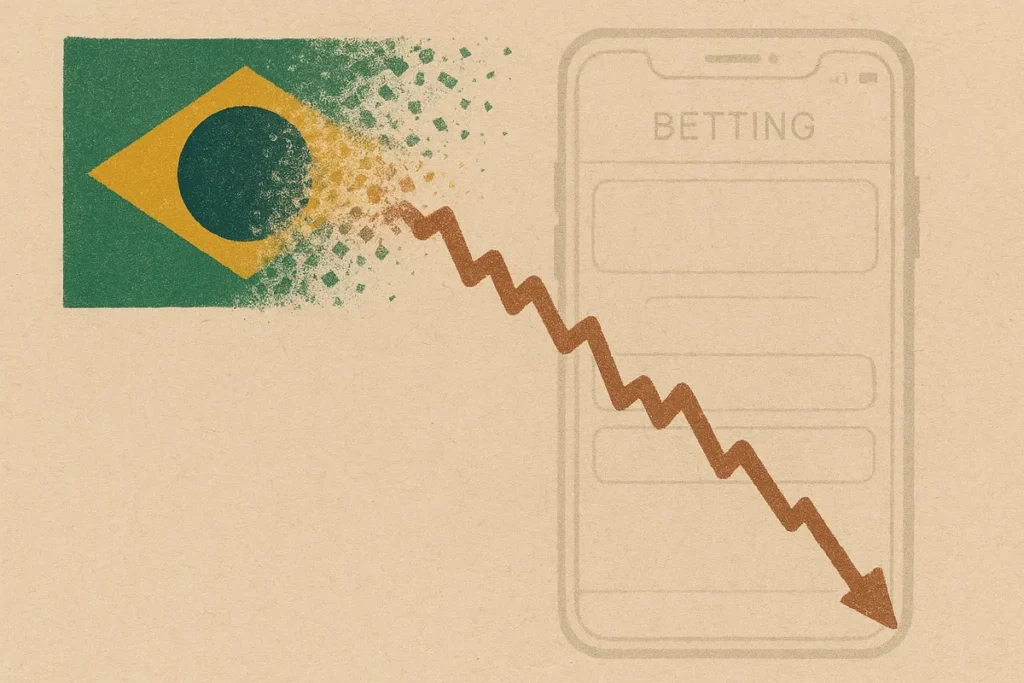
Brazil’s licensed online betting market lasted about 21 months. It opened on 1 January 2025 after years of lobbying, consultation and licence fees that ran into the tens of millions of reais per operator. On 28 September 2026, President Luiz Inácio Lula da Silva signed a provisional measure prohibiting online gambling, and the regulated market that global operators had spent a fortune entering was switched off.
Entain’s shares dropped 4% in Monday afternoon trading on the FTSE 250. Both Entain and Flutter went back to investors within days to rework their 2026 numbers. That sequence, a liberalisation that becomes a prohibition inside two years, is the most instructive regulatory story the industry has had in a decade, and most of the commentary around it has been wrong in predictable ways.
Brazil’s online gambling ban: the details
The Brazil online gambling ban was delivered through a provisional measure, an executive instrument that takes effect immediately but expires unless Congress approves it. The measure prohibits online gambling and effectively ends Brazil’s regulated online market. Congress has 120 days to convert it into permanent law; if legislators do not act, the measure lapses.
That distinction matters enormously and gets glossed over. Operators are complying now, with revenue stopping now, while the legal outcome stays unresolved for up to four months. Entain said it would comply but called itself “disappointed” by an announcement made “without consultation of industry stakeholders regarding its significant adverse consequences”. The stated driver from the government side is rising gambling addiction in Brazil.
The policy reversal is sharper when you lay out the sequence.
| When | What happened | Why it mattered |
|---|---|---|
| December 2023 | Law 14.790 sanctioned, creating a federal framework for fixed-odds betting and online gaming | Gave operators a legal route into Latin America’s largest market |
| Through 2024 | Licensing process, authorisation fees and technical requirements rolled out | Operators committed capital, acquisitions and marketing budgets |
| 1 January 2025 | Regulated online market goes live with authorised operators | Brazil becomes a core growth line in investor presentations |
| 28 September 2026 | Provisional measure signed prohibiting online gambling | Revenue stops; 2026 guidance is revised within days |
| Within 120 days | Congressional vote required for the ban to become permanent | Legal certainty is still pending while trading is already halted |
Myth: a licensed market is a protected market
The most expensive assumption in iGaming is that paying for a licence buys political durability. It does not. A licence buys permission that can be withdrawn by the same authority that granted it, and in Brazil’s case by an instrument that bypassed the usual legislative grind entirely.
Why did Brazil reverse course? The government’s justification is public health: problem gambling spread faster than the regulatory machinery could absorb it, particularly among lower-income households and recipients of social transfers, which became a recurring theme in Brazilian political debate through the regulated period. Add saturation-level advertising, football sponsorship on nearly every shirt, and a highly visible wave of consumer complaints, and prohibition became politically cheaper than incremental tightening.
Read the industry’s own description of the market and you can see the trap. Entain called Brazil a “challenging and highly competitive operating environment”, which is operator shorthand for brutal acquisition costs and thin margins. A market where everyone is spending aggressively to buy customers is also a market generating maximum social visibility per unit of profit. That combination is the clearest gambling regulation risk signal there is.
Myth: the financial hit was catastrophic for Flutter and Entain
It was not catastrophic, and pretending otherwise misreads the lesson. Both groups are large and geographically spread, which is exactly why the damage landed as a guidance revision rather than a crisis.
Flutter’s revenue exposure to Brazil
Flutter, the New York-listed owner of Paddy Power and Betfair, told the market that shutting its Brazilian operations for the remainder of 2026 would reduce full-year revenue and flow through to earnings. The company quantified that effect in its own investor update, and anyone modelling the position should take the figures from Flutter’s disclosure rather than from secondhand summaries. The structural point stands on its own: a market that was a growth engine in the plan became a subtraction line with no notice period and no transition window.
Entain’s forecast adjustments
Entain, the London-listed owner of Ladbrokes and Sportingbet, was more specific. It cut its full-year online net gaming revenue outlook to growth of 4% to 6%, and said underlying earnings would land at the lower end of its previous £910 million to £960 million guidance range (roughly $1,203.8 million to $1,270 million). Brazil had been expected to contribute around 5% of Entain’s total online net gaming revenue for the year, though the company said the earnings contribution was forecast to be “modest” given competitive conditions.
So a 5% revenue line disappearing produced a guidance trim and a 4% share price fall. The revenue was replaceable; the credibility of the growth story took the bigger knock. For a sector that trades on forward multiples, that is the part worth noticing.
Myth: single-digit exposure is a rounding error
Five percent of online NGR sounds survivable because it is. The problem is that nobody holds a single emerging-market position. Operators hold portfolios of them, and those positions correlate.
Brazil, India, several African markets and parts of Southeast Asia share the same risk DNA: large young populations, fast mobile adoption, heavy advertising, weak consumer-protection infrastructure and politically sensitive problem gambling data. India passed its own national legislation in August 2025 prohibiting online money gaming, which shut down a domestic real-money sector that had been attracting serious capital. Two of the world’s most-courted growth markets closed inside roughly a year of each other. That is not bad luck, it is a pattern.
Regulatory risk lessons for emerging gambling markets
The honest conclusion from Brazil is that emerging gambling markets should be underwritten as short-duration, high-volatility assets, not as annuities. Payback periods need to assume the licence may not survive the amortisation schedule.
Political risk indicators
The warning signs in Brazil were visible well before the signature. Operators monitoring jurisdictional risk should track:
- Public health framing entering mainstream political speech, especially linking gambling to household debt or welfare spending.
- Advertising saturation, particularly sports sponsorship visible to minors, which almost always precedes restriction.
- Executive instruments available in the constitutional toolkit, such as provisional measures, which allow change without a legislative majority first.
- Regulatory capacity lagging market growth, so enforcement against grey operators looks ineffective and prohibition looks like the simpler fix.
- Tax or fee disputes that erode the “we are a fiscal benefit” argument the industry relies on politically.
Market concentration dangers
Concentration risk in this sector is not only about one country being too large a share of revenue. It also shows up in acquisition-driven entries where goodwill sits on the balance sheet tied to a single licence, in earn-outs structured around local growth targets, and in marketing commitments such as multi-year sponsorship deals that keep running after trading stops. A clean 5% revenue exposure can carry a much larger balance sheet and contractual exposure behind it.
How global operators can mitigate jurisdictional risk
None of this argues for avoiding emerging markets. It argues for pricing them properly and building for reversibility.
- Cap exposure by jurisdiction explicitly. Set a board-level ceiling on the share of group revenue and, more importantly, group earnings any single non-core market may represent, and report against it.
- Underwrite entries on short horizons. If an acquisition only works on a ten-year view in a market where the framework is two years old, the valuation is carrying political risk it has not been paid for.
- Keep infrastructure portable. Shared platform, payments and risk stacks mean an exit costs you a market, not a technology write-off.
- Write exit mechanics into contracts. Sponsorships, media deals and local partnerships should contain regulatory termination clauses, not just force majeure boilerplate.
- Invest in the compliance argument early. Deposit limits, self-exclusion, advertising restraint and credible affordability checks are the industry’s only real defence when the debate turns to addiction. Operators that look like part of the problem lose the argument first.
- Diversify across regulatory models, not just geographies. Mature markets with entrenched statutory frameworks and multi-stage legislative processes are slower to grow and much harder to switch off.
Brazil’s reversal was not a black swan. It was a predictable consequence of a market that grew faster than its guardrails, in a political system where a single executive instrument can close it. Operators who treat that as an outlier will be revising guidance again.
Frequently asked questions
What does Brazil’s gambling ban mean in practice?
Online gambling is prohibited under a provisional measure signed on 28 September 2026, so licensed operators have stopped serving Brazilian customers online. The measure needs congressional approval within 120 days to become permanent law.
Why did Brazil ban online gambling?
The government’s stated reason is rising gambling addiction. Concern about the social cost of heavy betting participation, particularly among lower-income households, built steadily through the regulated period alongside saturation advertising.
How does gambling regulation affect operators financially?
Immediately and non-negotiably. Entain cut its full-year online net gaming revenue growth outlook to 4% to 6% and guided earnings to the lower end of its £910 million to £960 million range; Flutter flagged a reduction to full-year revenue and earnings from suspending its Brazilian operations. Share prices moved on the day.
What are the main risks in emerging gambling markets?
Licence frameworks that can be reversed by executive action, political sensitivity around problem gambling, advertising backlash, competitive intensity that compresses margins, and balance sheet exposure through acquisitions and long-term local commitments.
Gambling carries a built-in house edge and involves real risk of financial harm. If betting is affecting your finances or wellbeing, use deposit and loss limits, self-exclusion tools, or contact a support service in your country.